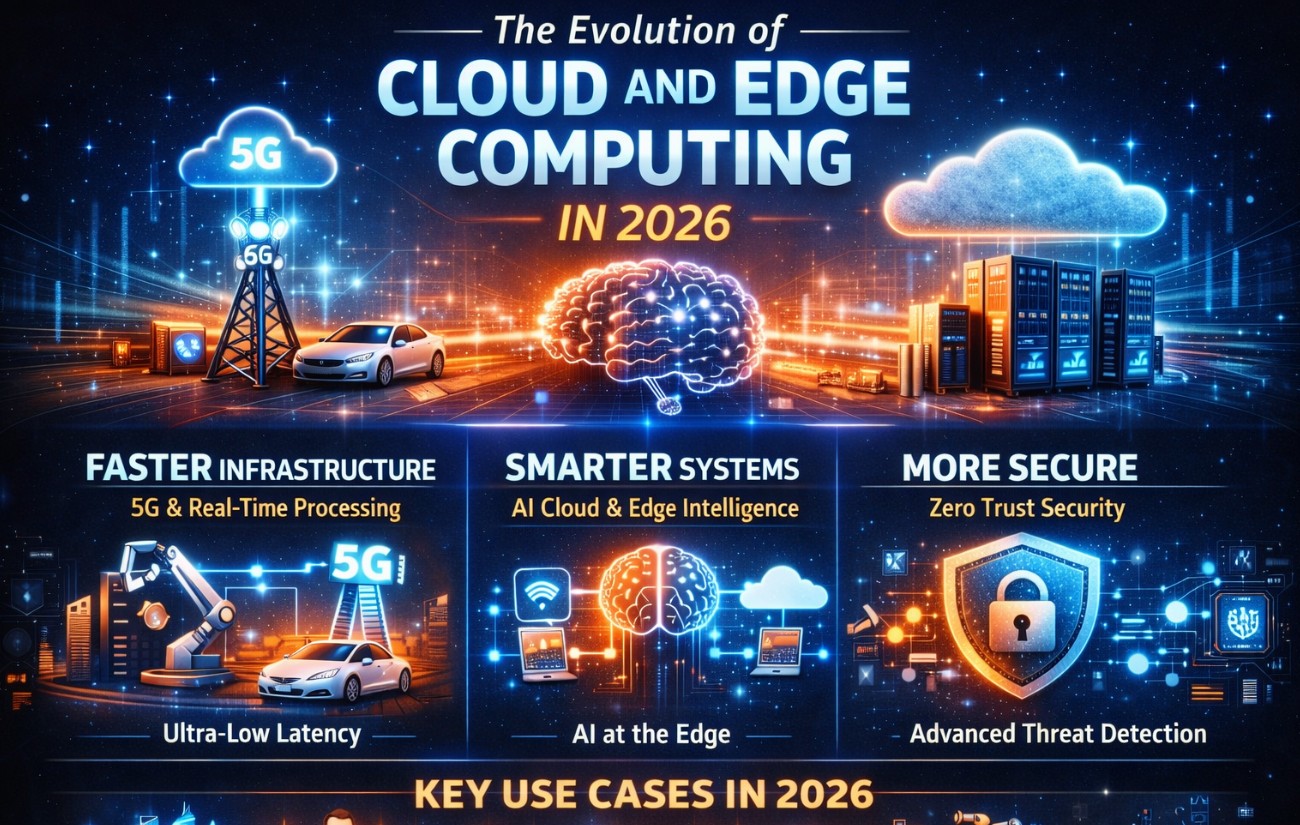
n 2026, advanced foundation is experiencing a significant change. As information volumes detonate, applications request real-time execution, and cybersecurity dangers escalating, cloud computing alone is no longer sufficient. The meeting of cloud and edge computing is reshaping how businesses, governments, and customers associated with technology—making frameworks quicker, more astute, and altogether more secure.
This advancement is not fair a specialized overhaul; it is a vital move that characterizes the future of counterfeit insights (AI), Web of Things (IoT), keen cities, healthcare, fintech, and next-generation advanced services.
Understanding Cloud and Edge Computing in 2026
What Is Cloud Computing Today?
Cloud computing gives centralized get to to computing control, capacity, and applications through the web. Industry pioneers like Amazon Web Administrations, Microsoft Sky blue, and Google Cloud proceed to rule the worldwide showcase by advertising adaptable, pay-as-you-go infrastructure.
What Makes Edge Computing Different?
Edge computing forms information closer to where it is generated—such as sensors, smartphones, independent vehicles, and mechanical machines. Instep of sending all information to far off cloud servers, edge frameworks handle time-sensitive workloads locally, diminishing inactivity and transfer speed costs.
In 2026, the genuine development lies in cloud–edge integration, where both innovations work consistently together.
Why Cloud and Edge Computing Are Converging
The fast development of associated gadgets and AI-driven applications has made conventional centralized models wasteful. Key drivers behind this joining include:
- Ultra-low idleness necessities for AR/VR, gaming, and independent systems
- Massive IoT development over shrewd homes, industrial facilities, and cities
- AI at the edge for real-time decision-making
- Rising information protection controls requesting localized information processing
This crossover approach permits businesses to run mission-critical operations at the edge whereas utilizing the cloud for analytics, organization, and long-term storage.
Faster Foundation: The Idleness Revolution
Speed is the most unmistakable advantage of edge-enabled cloud infrastructure.
Real-Time Processing
In 2026, applications such as independent vehicles, telemedicine, and mechanical mechanical technology cannot endure delays. Edge computing empowers millisecond-level reaction times, whereas the cloud handles coordination and intelligence.
5G and Beyond
The worldwide rollout of 5G—and early advancement of 6G—has quickened edge appropriation. High-speed network guarantees that edge gadgets match up productively with cloud stages, empowering real-time experiences without overpowering central servers.
Result: Quicker apps, smoother client encounters, and higher client retention—critical measurements for computerized businesses and sponsors alike.
Smarter Frameworks: AI-Powered Cloud–Edge Intelligence
Artificial insights is the spine of present day advanced foundation in 2026.
AI at the Edge
Edge AI permits gadgets to analyze information locally—such as facial acknowledgment, prescient support, and extortion detection—without sending delicate data to the cloud.
Cloud as the Brain
The cloud remains the central insights center, dependable for:
- Training huge AI models
- Aggregating bits of knowledge from millions of edge nodes
- Managing upgrades, arrangements, and orchestration
This disseminated insights show makes frameworks more astute, more versatile, and profoundly scalable.
More Secure Computerized Framework in 2026
Security is no longer optional—it is a competitive advantage.
Zero Believe Architecture
Modern cloud–edge situations take after a Zero Believe security show, where no gadget or client is trusted by default. Each ask is confirmed, scrambled, and persistently monitored.
Reduced Assault Surface
By preparing delicate information locally at the edge, organizations diminish introduction to large-scale information breaches. Indeed if one hub is compromised, the in general framework remains protected.
AI-Driven Risk Detection
AI-powered cybersecurity devices analyze behavior designs in genuine time, recognizing peculiarities some time recently they ended up major occurrences. This is particularly basic for divisions like back, healthcare, and government services.
Industry Utilize Cases Driving Growth
Smart Cities
Edge-enabled cloud frameworks oversee activity, vitality conveyance, squander administration, and open security with real-time responsiveness.
Healthcare and Telemedicine
Wearable gadgets and farther diagnostics depend on edge computing for moment alarms, whereas cloud stages store understanding records safely and guarantee administrative compliance.
E-Commerce and Fintech
Low-latency edge servers make strides checkout speeds, distinguish extortion right away, and personalize client experiences—directly affecting change rates and advertisement revenue.
Manufacturing and Industry 4.0
Factories utilize edge AI for prescient support and computerization, whereas cloud dashboards give worldwide perceivability and optimization.
Economic Affect and Trade Advantages
For businesses and distributers, the cloud–edge advancement conveys substantial benefits:
- Lower operational costs through optimized information transfer
- Higher uptime and reliability
- Improved compliance with information security laws
- Better monetization openings through quicker, personalized computerized experiences
These preferences clarify why worldwide investing on cloud and edge foundation proceeds to develop at double-digit rates in 2026.
Challenges That Still Remain
Despite fast advance, challenges persist:
- Infrastructure complexity
- Edge gadget administration at scale
- Skilled workforce shortages
- Interoperability over vendors
However, open measures, AI robotization, and overseen edge administrations are consistently tending to these barriers.
The Future Viewpoint: What Comes Next?
Looking past 2026, cloud and edge computing will advance into a completely independent computerized texture, where foundation self-optimizes based on workload, security chance, and client demand.
Key patterns to watch:
- Edge-native AI models
- Quantum-safe cloud security
- Carbon-aware cloud infrastructure
- Fully computerized DevOps and NetOps
Final Thoughts
The advancement of cloud and edge computing in 2026 marks a turning point in advanced history. Together, they make an framework that is speedier, more intelligent, and more secure—capable of supporting AI-driven advancement, real-time administrations, and privacy-first advanced environments.
About the Author