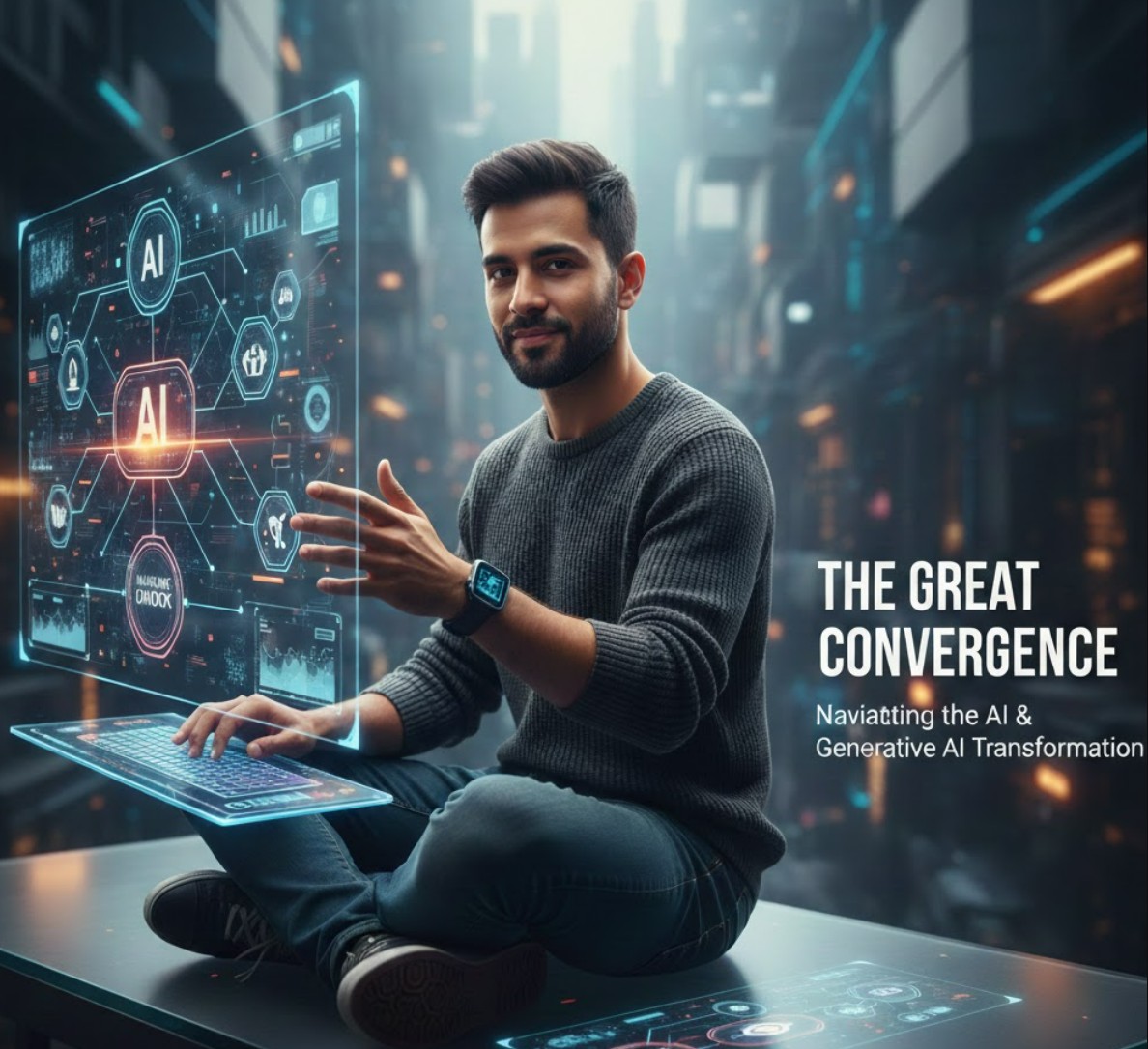
As we move through 2025, the discussion encompassing Fake Insights has moved from theoretical ponder to mechanical need. We are no longer only “testing” with calculations; we are seeing a principal rebuilding of the worldwide economy. Whereas “Conventional AI” has long served as the quiet motor of prescient analytics and design acknowledgment, the entry of Generative AI (GenAI) has included a inventive and cognitive layer that is rethinking what machines can achieve.
This change is not fair a innovative upgrade—it is a worldview move in how human insights and machine capability converge.
From Examination to Activity: The Advancement of AI
To get it the current change, one must recognize between the two columns of cutting edge insights. Conventional AI—often called Discriminative AI—is outlined to categorize and anticipate. It looks at a million photographs of credit card exchanges and banners the one that looks like extortion. It is the ace of analysis.
Generative AI, be that as it may, speaks to the ace of creation. Built on Expansive Dialect Models (LLMs) and dissemination models, GenAI doesn’t fair recognize a design; it employments that design to create something completely new—be it a line of code, a lawful brief, a therapeutic determination, or a cinematic video. In 2025, the most noteworthy slant is the rise of Agentic AI: frameworks that do not fair “chat” but can really execute multi-step workflows, connected with computer program, and make independent choices to accomplish a goal.
Industrial Reshaping: The ROI of Innovation
The financial affect of this move is stunning. Investigate from organizations like McKinsey and Goldman Sachs recommends that Generative AI might include between $2.6 trillion and $4.4 trillion yearly to the worldwide economy. This esteem is being realized over four essential domains:
1. Program Designing and IT
The tech division has been the to begin with to experience a add up to transformation. With instruments like GitHub Copilot and specialized LLMs, 97% of IT specialists presently utilize AI for coding and investigating. This has not driven to the “conclusion of programming” but or maybe to a 30–50% diminishment in improvement cycles. Designers are moving from “scholars of code” to “modelers of rationale,” directing AI-generated modules that are delivered in seconds.
2. Healthcare and Life Sciences
In healthcare, the change is life-saving. AI is being utilized to crease proteins and reenact atomic intelligent, cutting the medicate revelation timeline from a long time to months. On the front lines, multimodal AI—which can handle content, pictures, and sound simultaneously—allows specialists to cross-reference understanding histories with real-time symptomatic checks, recognizing peculiarities that the human eye might miss.
3. Money related Services
The budgetary segment has moved past straightforward robo-advisors. Nowadays, “AI specialists” perform real-time hazard appraisal and extortion discovery with surgical exactness. Banks are leveraging GenAI to synthesize thousands of pages of administrative filings into noteworthy bits of knowledge, guaranteeing compliance in an progressively complex worldwide market.
4. Imaginative and Showcasing Industries
The “substance bottleneck” has been smashed. Promoting groups presently utilize GenAI to deliver hyper-personalized campaigns at scale. A single imaginative concept can be right away localized into fifty diverse dialects and adjusted for ten distinctive social media designs, all whereas keeping up a reliable brand voice.
The Workforce Insurgency: Expansion vs. Displacement
One of the most significant changes is happening in the labor advertise. The story of “robots taking employments” is being supplanted by a more nuanced reality: AI Augmentation.
Data from 2025 shows that whereas around 300 million employments all inclusive seem be influenced by mechanization, the larger part of these parts will be changed or maybe than eliminated.
High Presentation: Parts including tedious information processing—such as bookkeepers, lawful colleagues, and client benefit reps—are seeing the most critical assignment automation.
New Openings: Alternately, we are seeing the birth of unused callings: AI Ethicists, Provoke Engineers, and AI Arrangements Architects.
The “aptitudes crevice” has gotten to be the essential challenge for CEOs. The World Financial Gathering gauges that over 1.4 billion laborers will require reskilling by 2028. The competitive advantage no longer lies with the company that has the best AI, but with the company whose representatives know how to utilize it best.
Ethical Guardrails and the “Believe Gap”
As AI gets to be more independent, the dangers ended up more intense. The change is right now confronting three major “contact focuses” that will characterize the another decade of development:
Hallucinations and Precision: In spite of progressions, LLMs can still create “hallucinations”—confident but wrong data. In 2025, the industry has turned to Retrieval-Augmented Era (Cloth) to ground AI yields in confirmed, real-world data.
Bias and Decency: Since AI is prepared on human information, it reflects human partialities. Organizations are presently executing “AI Decency Toolkits” to review their models for sex, racial, and financial predisposition some time recently deployment.
Data Sway: With the “information divider” approaching—where high-quality human-generated information is getting to be scarce—companies are turning to manufactured information to prepare their models. This raises unused questions almost the “inbreeding” of AI models and the misfortune of unique human nuance.
Conclusion: The Human-Centric Future
The change started by AI and Generative AI is not a goal, but a travel toward a modern kind of “Collective Efficiency.” We are moving into an time where the refinement between “human work” and “computer work” is blurring.
The most fruitful organizations of the late 2020s will not be those that supplant people with machines, but those that utilize machines to increase human potential. By robotizing the ordinary, AI is incomprehensibly constraining us to be more human—prioritizing inventiveness, sympathy, and key judgment.
As we see toward 2030, the AI change will likely be seen not as the “Rise of the Machines,” but as the “Advancement of the Intellect.” The devices are in our hands; the challenge presently is to construct a future that is as moral as it is proficient.
About the Author