In the early decades of the digital era, software development was a walled garden. Building an application required years of specialized training, mastery of complex syntax, and deep knowledge of computer science fundamentals. However, as we move through 2025, those walls have not just been breached—they are being systematically dismantled.
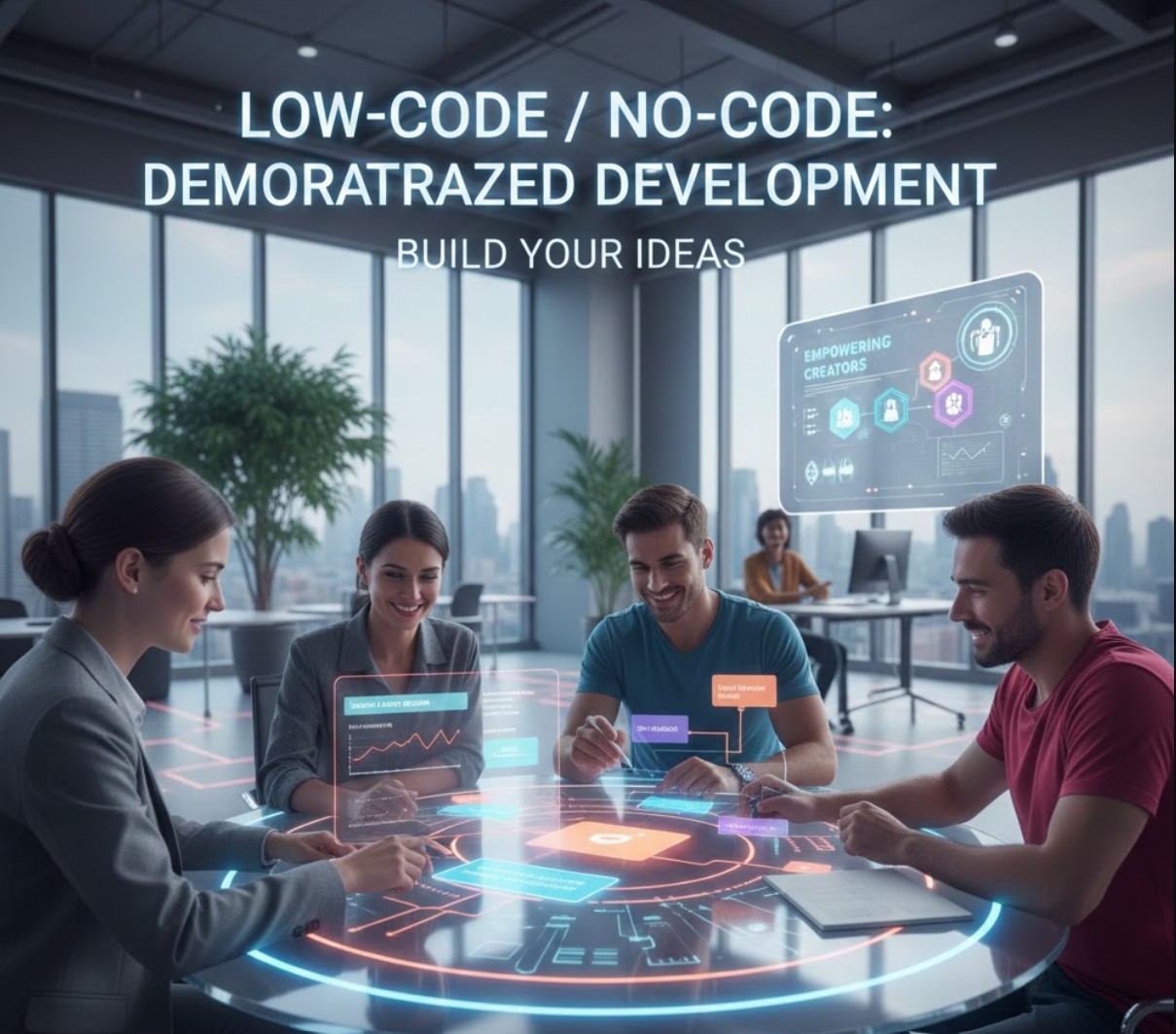
The rise of Low-Code and No-Code (LCNC) platforms has ushered in the era of Democratized Development, a paradigm shift where the ability to create software is no longer a rare privilege, but a common professional skill.
1. Defining the Spectrum: No-Code vs. Low-Code
While often grouped together, these two approaches serve different needs and audiences. Understanding their distinction is key to navigating the modern development landscape.
No-Code: The Drag-and-Drop Revolution
No-code platforms are designed for the “Citizen Developer”—business analysts, marketers, or HR managers with zero programming background. These tools use visual interfaces, allowing users to assemble applications like Lego sets.
-
Core Mechanics: Visual modeling, drag-and-drop components, and pre-configured templates.
-
Best For: Simple workflow automations, internal tracking tools, and rapid prototyping.
Low-Code: The Professional’s Turbocharger
Low-code platforms target professional developers and tech-savvy analysts. While they use visual builders to handle 80–90% of the heavy lifting, they allow for the injection of custom scripts to handle complex logic or unique integrations.
-
Core Mechanics: Graphical interfaces supplemented by traditional coding environments (C#, JavaScript, Python).
-
Best For: Enterprise-grade applications, legacy system modernization, and high-scale consumer apps.
2. The Pillars of Democratized Development
Democratization is the process of making a high-value resource available to everyone. In tech, this is driven by three primary catalysts:
Accessibility of Logic
Previously, “thinking like a coder” meant understanding memory management and syntax. Today, LCNC platforms translate business logic directly into execution. If you can draw a flowchart of a business process, you can likely build the app that manages it.
The Rise of the Citizen Developer
Organizations are increasingly empowering non-technical employees to solve their own problems. Instead of waiting six months for a busy IT department to build a simple vacation-tracking tool, an HR manager can build it in a weekend using a no-code platform.
AI-Augmented Creation
In 2025, Generative AI has become the “brain” inside the LCNC engine. Users can now describe a feature in plain English—“Build a dashboard that alerts me when inventory drops below 10%”—and the platform generates the underlying architecture automatically.
3. Why Now? The Economic and Cultural Drivers
The surge in democratized development isn’t just about cool new tools; it’s a response to a global necessity.
| Driver | Impact on Business |
| The Developer Shortage | With a massive gap between software demand and available talent, LCNC fills the void. |
| Hyper-Agility | Markets move faster than traditional development cycles. LCNC cuts “Time to Value” from months to days. |
| Cost Efficiency | Reduces the reliance on expensive specialized teams for routine internal tools. |
| Shadow IT Mitigation | When IT provides sanctioned LCNC tools, employees stop using unsecure third-party apps to get work done. |
4. The Lifecycle of an LCNC Application
Building in a democratized environment follows a streamlined path compared to the traditional Software Development Life Cycle (SDLC).
-
Requirement Definition: Identifying the business bottleneck.
-
Platform Selection: Choosing between a general-purpose tool (like Microsoft Power Apps) or a niche tool (like Bubble for web or Adalo for mobile).
-
Visual Assembly: Dragging UI elements and defining data relationships.
-
Integration: Connecting to existing data sources (SQL, Excel, Salesforce) via APIs.
-
Governance & Review: IT oversight to ensure security and compliance.
-
Deployment: Instant “one-click” publishing to web or mobile.
5. Challenges and the “Governance” Guardrail
Democratization is not without its risks. “Power to the people” can lead to chaos if not managed correctly.
-
Security Vulnerabilities: Citizen developers may not understand data encryption or secure authentication protocols.
-
App Proliferation: Without oversight, a company can end up with 500 different “v1.0” apps that are redundant or abandoned.
-
Scalability Walls: A no-code app built for 10 people might crash when scaled to 1,000.
The Solution: Organizations are adopting “Co-Creation” models where IT sets the security guardrails and provides the “building blocks,” while business users build the actual solutions within those safe zones.
6. The Future: Where We Are Heading
As we look toward the end of the decade, the line between “using a computer” and “programming a computer” will continue to blur. We are moving toward Natural Language Development, where the software is shaped through conversation rather than configuration.
Democratized development isn’t replacing professional software engineers; it’s elevating them. Pro-coders are becoming architects of the systems that enable others to build.22 They focus on the high-level infrastructure, security, and complex algorithms, while the rest of the workforce solves the millions of “last-mile” problems that make a business run.
Conclusion
The democratization of development through Low-Code and No-Code is the ultimate expression of technology’s purpose: to empower human intent. By removing the barrier of syntax, we unlock the collective creativity of the entire workforce. In this new world, the best “developer” isn’t necessarily the one who knows the most languages, but the one who best understands the problem they are trying to solve.
-
About the Author