The landscape of software engineering is currently undergoing its most significant transformation since the advent of the internet. In 2025, the industry has moved past the initial hype of “chatbots that code” to a sophisticated era of AI-Enhanced Development. This paradigm shift is not merely about replacing keystrokes with prompts; it is about a fundamental restructuring of the Software Development Lifecycle (SDLC) into a symbiotic relationship between human creativity and machine intelligence.1
1. The Anatomy of AI-Enhanced Development
At its core, AI-enhanced development refers to the integration of Artificial Intelligence—particularly Generative AI (GenAI), Large Language Models (LLMs), and Agentic AI—across every phase of software creation.2
Unlike traditional “Auto-complete” tools, modern AI-enhanced environments are context-aware.3 They don’t just suggest the next line of code; they understand the entire repository, the architectural patterns in use, and even the business logic requirements.
Key Components of the AI Tech Stack:
-
Agentic IDEs: Tools like Cursor, Windsurf, and GitHub Copilot have evolved into agents that can reason, run terminal commands, and refactor entire modules autonomously.4
-
Automated Testing Agents: AI now generates, executes, and “self-heals” test cases, adapting them as the UI or backend logic changes.5
-
AI-Powered DevOps: Continuous Integration and Deployment (CI/CD) pipelines now use predictive analytics to spot potential deployment failures before they happen.6
2. Redefining the SDLC: From Planning to Maintenance7
The traditional SDLC stages—Planning, Design, Implementation, Testing, and Deployment—are all being compressed and optimized by AI.8
Planning and Analysis
AI agents can now ingest sprawling product requirement documents and translate them into actionable Jira tickets or GitHub issues.9 By analyzing historical project data, AI provides highly accurate velocity estimations, helping teams avoid the common pitfall of over-promising and under-delivering.10
Design and Prototyping
Tools are emerging that allow developers to convert high-fidelity UI designs (from Figma or screenshots) directly into functional React or Vue components.11 This “design-to-code” bridge significantly reduces the friction between creative teams and engineering.
Implementation: The “Head Chef” Model
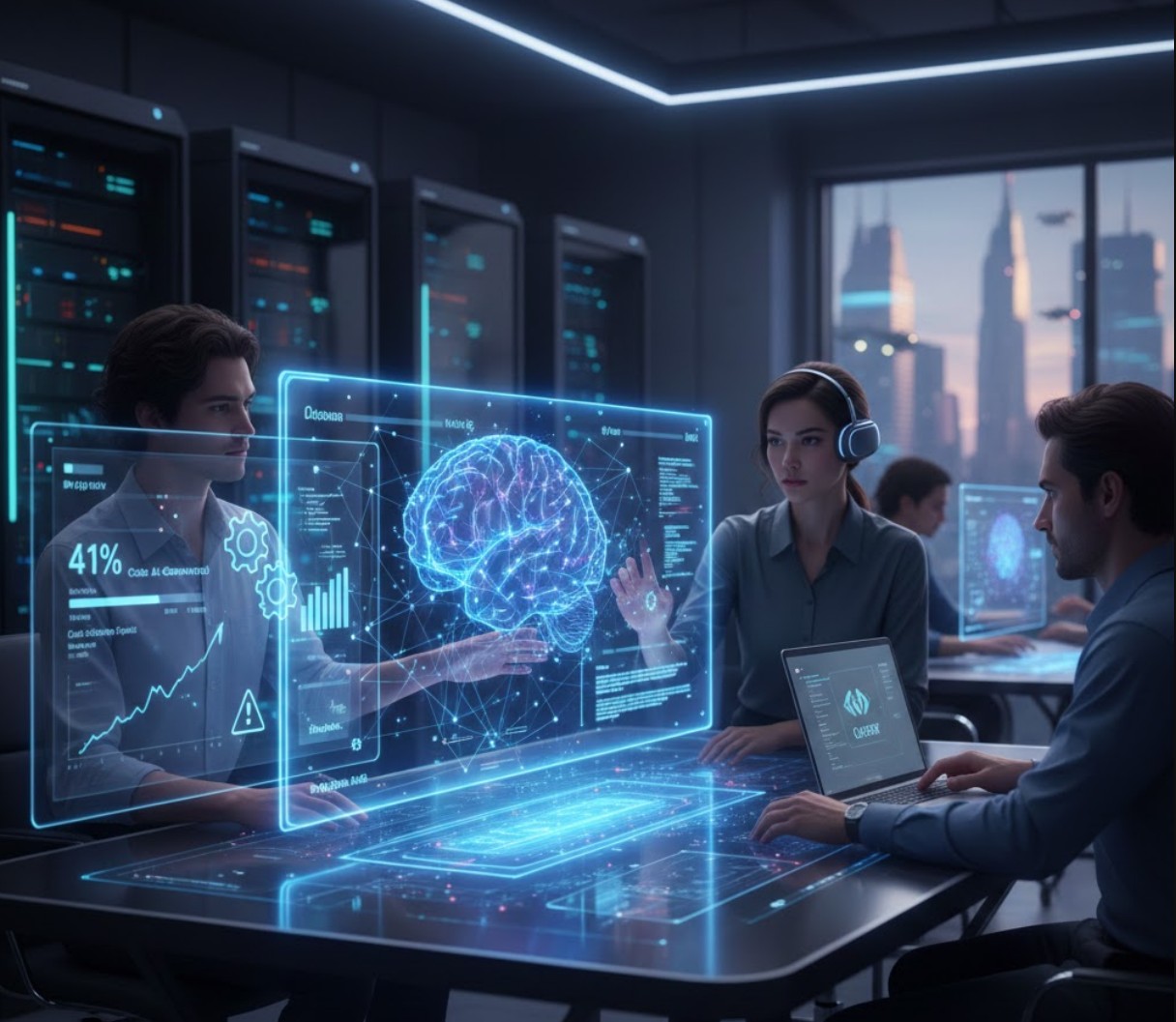
In 2025, the role of the developer is shifting from a “line cook” (writing every line of boilerplate) to a “Head Chef.” AI handles the repetitive tasks—writing data models, basic API endpoints, and documentation—while the human developer focuses on system architecture, security, and complex logic.12 Statistics show that in 2025, roughly 41% of all code is AI-generated, yet human oversight remains the critical final gate.13
3. The Impact on Productivity and Quality
The data for 2025 reveals a complex but promising picture of AI’s impact on the engineering workforce.
The Productivity Paradox
Surveys indicate that 84% of developers now use AI tools daily, reporting a productivity boost of 10% to 30%.14 However, there is a “productivity paradox”: while developers feel faster, tasks can sometimes take longer due to the “review tax.”15 Developers spend less time typing but significantly more time debugging and auditing AI-generated outputs.
Quality and Technical Debt
One of the emerging risks is the proliferation of “Code Clones.” Research suggests a 4x increase in code duplication as developers copy-paste AI suggestions without proper refactoring.16 To combat this, AI-enhanced development now includes “intelligent refactoring” tools that proactively identify redundant patterns and suggest modular abstractions to keep the codebase “DRY” (Don’t Repeat Yourself).
| Metric | Impact of AI (2025) |
| Development Speed | 20-55% faster for boilerplate tasks |
| Test Coverage | Significant increase through autonomous generation |
| Security | Improved via real-time vulnerability scanning |
| Code Maintainability | Risk of decrease due to increased code volume |
4. Challenges and Ethical Considerations
The transition to AI-enhanced development is not without its hurdles.
-
The Context Gap: Even the most advanced LLMs can struggle with the “Long Tail” of project context. Senior developers often report frustration when an AI misses a nuanced architectural constraint that a human teammate would have intuitively known.
-
Security and Privacy: As developers feed snippets into cloud-based LLMs, the risk of leaking proprietary logic or secrets remains high. This has led to the rise of Local-First AI, where models run on-device or within a secure private cloud.17
-
Skill Atrophy: There is a growing concern that junior developers may bypass the “struggle” of learning fundamental concepts, leading to a potential talent gap in the future when high-level reasoning is required to fix an AI’s subtle logic error.
5. The Future: Towards “Software 2.0”
Looking toward 2027 and beyond, we are moving toward Autonomous Quality Platforms.18 In this future, the AI doesn’t just help you write code; it manages the lifecycle of the code.19 If a performance bottleneck is detected in production, an AI agent will automatically create a branch, write a fix, run the tests, and submit a Pull Request for human approval.
Upskilling for the New Era
To thrive, modern engineers must move beyond being “language experts” and become “Orchestrators.” Proficiency in AI tools is becoming a mandatory skill, alongside:
-
Prompt Engineering for Code: Learning how to provide the right context and constraints to get high-quality output.20
-
Code Auditing: Developing a keen eye for subtle logical flaws in machine-generated blocks.
-
Systemic Thinking: Focusing on how components interact rather than how individual functions are written.
Conclusion
AI-enhanced development is not the end of the software engineer; it is the evolution. By offloading the mundane and the repetitive to intelligent agents, developers are being freed to solve the world’s most complex problems.21 The most successful engineers of tomorrow will be those who view AI not as a replacement, but as a high-powered exoskeleton for their intellect.
About the Author