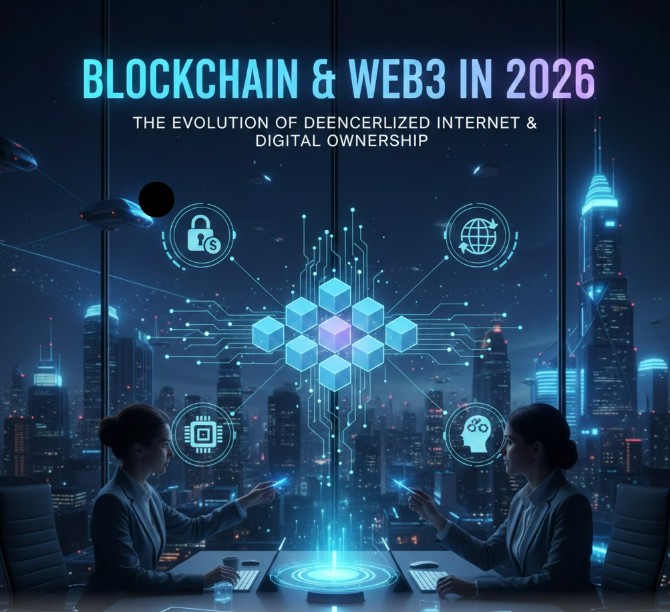
The advanced scene is advancing quickly, and 2026 marks a urgent year for blockchain innovation and Web3. As the concept of a decentralized web picks up standard footing, both people and businesses are investigating unused ways to connected, execute, and claim computerized resources safely and straightforwardly. This change guarantees not as it were to reshape the way we utilize the web but too to rethink advanced possession, protection, and financial models.
Understanding Blockchain and Web3
Blockchain is the fundamental innovation fueling Web3, acting as a disseminated record that guarantees straightforwardness, security, and permanence of information. Not at all like conventional centralized frameworks, blockchain works on decentralized systems, expelling mediators and permitting peer-to-peer interactions.
Web3, frequently called the decentralized web, builds on blockchain standards to grant clients more noteworthy control over their advanced characters, information, and resources. In 2026, Web3 is no longer a specialty experiment—it’s developing as a standard elective to the current web show, empowering a unused period of computerized interest and ownership.
Key Patterns in Blockchain and Web3 for 2026
1. Mass Appropriation of Decentralized Fund (DeFi)
DeFi stages are reclassifying back by advertising loaning, borrowing, and exchanging without conventional banks. In 2026, more clients are anticipated to grasp decentralized money related frameworks, bolstered by improved adaptability, quicker exchanges, and user-friendly interfaces.
2. NFTs and Computerized Possession Past Art
Non-Fungible Tokens (NFTs) have advanced past advanced craftsmanship. In 2026, NFTs speak to real-world resources, mental property, gaming resources, and indeed genuine domain. This move empowers secure confirmation of possession and unused monetization models for makers and investors.
3. Interoperable Web3 Ecosystems
Web3 stages are progressively interoperable, permitting consistent exchange of resources, information, and personalities over diverse systems. This interoperability cultivates a associated decentralized biological system, boosting proficiency and adoption.
4. Decentralized Character and Privacy
With developing concerns over information breaches, Web3 presents decentralized personality arrangements where clients control their individual data. Blockchain guarantees information judgment whereas permitting specific sharing, making security a center include of the unused internet.
5. Undertaking Blockchain Integration
In 2026, expansive organizations are grasping blockchain for supply chain straightforwardness, secure record-keeping, and mechanized savvy contracts. This integration diminishes operational costs, mitigates extortion, and builds shopper trust.
Challenges Confronting Blockchain and Web3 Adoption
Despite its potential, blockchain and Web3 confront challenges that must be tended to in 2026:
- Regulatory Instability: Governments around the world are creating arrangements for decentralized frameworks, making both openings and compliance challenges.
- Scalability Issues: Whereas Layer 2 arrangements are making strides, tall exchange costs and moderate speeds still influence standard adoption.
- User Encounter: Web3 interfacing are getting to be more instinctive, but mass selection depends on basic, open platforms.
The Future of Computerized Ownership
In 2026, the concept of possession is changing. Advanced resources, from NFTs to cryptocurrencies, engage clients with control over what they claim online. Keen contracts computerize exchanges, guaranteeing believe and diminishing dependence on mediators. This computerized proprietorship insurgency is balanced to affect amusement, genuine domain, fund, and indeed social intelligent, making unused financial models in the decentralized world.
How Businesses Can Use Web3
Businesses looking to flourish in 2026 must consider Web3 integration strategies:
- Launch tokenized dependability programs to remunerate client engagement.
- Implement NFT-based mental property rights to monetize advanced creations.
- Explore decentralized marketplaces for items, administrations, or content.
- Use blockchain for supply chain straightforwardness, guaranteeing moral sourcing and trust.
Companies that receive Web3 early will pick up a competitive edge, engaging to tech-savvy buyers and trailblazers in the decentralized economy.
Conclusion
Blockchain and Web3 are no longer cutting edge concepts—they are forming the web and computerized proprietorship in real-time. By 2026, decentralized advances will rethink how we associated online, oversee computerized resources, and construct believe in a digital-first world. Early adopters, whether people, businesses, or governments, will have a special opportunity to use this worldview move, making imaginative arrangements in back, character, commerce, and beyond.
The decentralized web is here to remain, and those who grasp Web3 in 2026 are likely to lead the following wave of computerized development.
About the Author