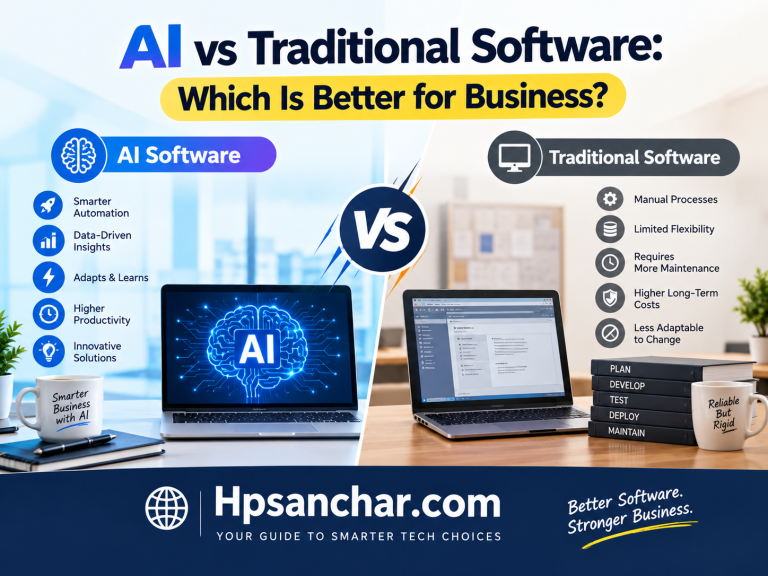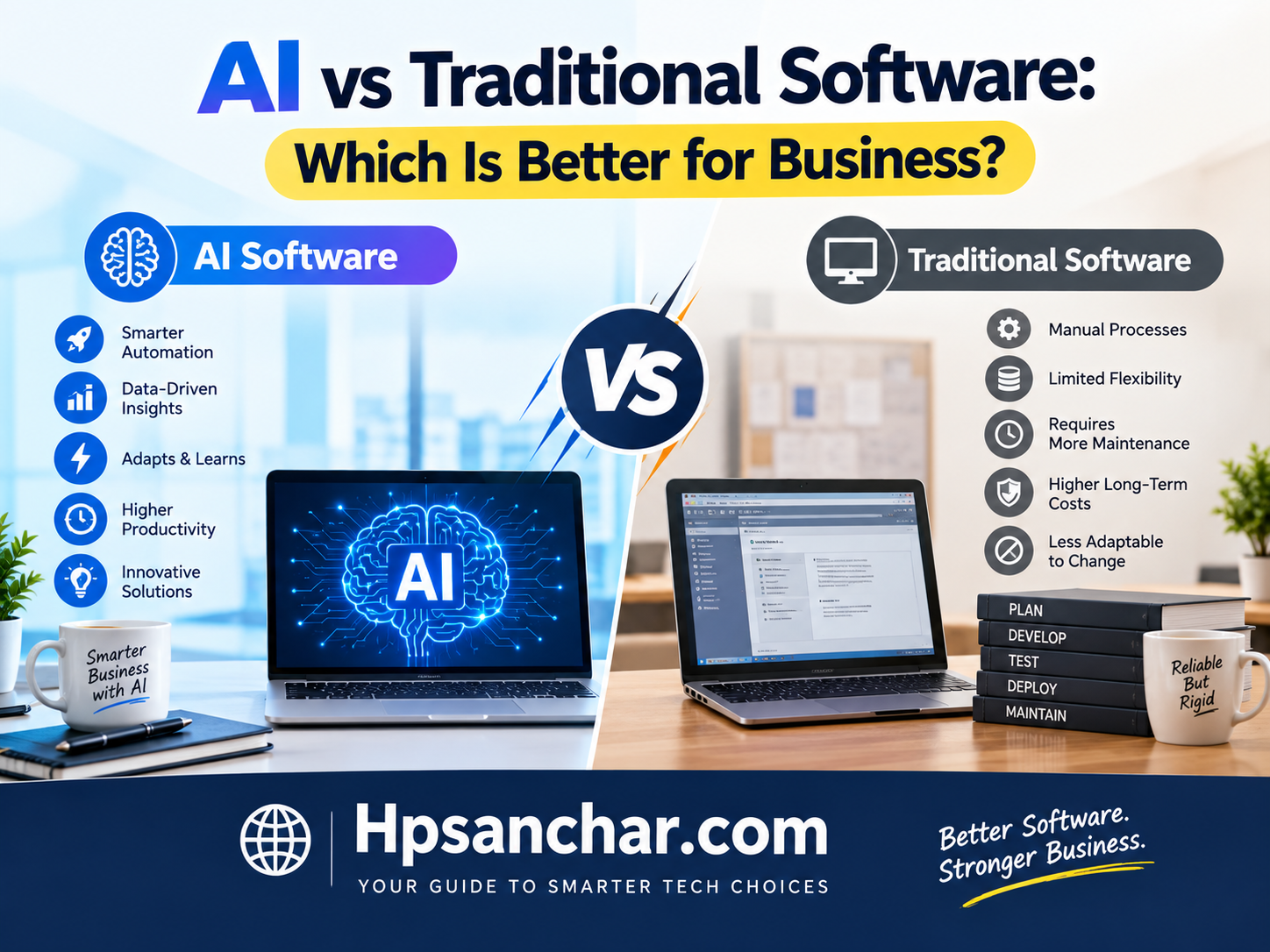
AI vs Traditional Software: Which Is Better for Business?
Determining whether to build or buy artificial intelligence versus traditional, rule-based software is the defining architectural decision for modern organizations. While AI models dominate technology headlines, standard deterministic software continues to handle the vast majority of global enterprise workloads.
The choice is not about choosing which technology is universally “better”—it is about matching software mechanics to business risk. Deploying probabilistic AI models when deterministic logic is required introduces hallucinations and unpredictable operational expenses (OpEx). Conversely, relying strictly on traditional code for unstructured data and complex pattern recognition leads to brittle, unmaintainable rule engines.
Core Architectural Comparison
| Strategic Dimension | Traditional Deterministic Software | Artificial Intelligence & Machine Learning |
| Logic Foundation | Explicit rules (if/then/else), rigid database schemas |
Probabilistic weights, neural embeddings, semantic patterns |
| Output Predictability | 100% deterministic; identical input produces identical output | Probabilistic; outputs vary based on context, temperature, and tokens |
| Cost Model | High initial CapEx (build), predictable and low recurring OpEx | Moderate upfront entry, variable/unpredictable inference OpEx (tokens) |
| Handling Ambiguity | Fails completely on unstructured inputs | Excels at parsing messy language, images, audio, and documents |
| Maintenance Burden | Code refactoring, bug patches, schema updates | Data pipeline curation, evaluation harnesses, drift mitigation |
| Auditability & Compliance | Full stack traceability, auditable unit test coverage | Black-box opacity; requires external guardrail monitoring |
How Traditional Software Operates
Traditional software operates on rule-based, deterministic logic. Software engineers write explicit programmatic instructions detailing how an application must behave under every possible condition.
If an input matches a condition, the output is guaranteed:
-
The Engine: Relational databases (PostgreSQL, MySQL), hardcoded business logic, and standard REST/GraphQL APIs.
-
The Strength: Absolute certainty. A billing ledger calculating transaction fees must yield the exact same penny every time it runs.
-
The Weakness: Extreme rigidity. If an unexpected format, misspelled address, or corrupt data string enters the workflow, the application throws an exception and breaks until an engineer rewrites the code.
Prime Business Use Cases
-
Financial Ledgering & Accounting: ERPs (SAP, NetSuite), double-entry bookkeeping, and payment processing engines (Stripe).
-
Inventory Management & Supply Logistics: Relational databases tracking physical unit counts across distribution centers.
-
Access Control & Identity Provisioning: RBAC (Role-Based Access Control) platforms like Okta and Entra ID verifying precise user permissions.
How AI-Native Systems Operate
Artificial intelligence, specifically generative AI and deep neural networks, replaces static human-authored rules with statistical pattern recognition. Rather than following rigid code, models are trained on massive volumes of data to infer relationships, generate text, categorize images, and make probabilistic predictions.
-
The Engine: Transformer architectures, vector databases (Pinecone, Qdrant), embedding models, and multi-agent coordination frameworks.
-
The Strength: Dynamic flexibility. AI models effortlessly process unstructured inputs—such as blurry scanned invoices, conversational emails, audio logs, and open-ended customer queries.
-
The Weakness: Nondeterministic variance. A model that executes a business task with 98% accuracy still fails 2 out of every 100 times, requiring defensive architecture and human-in-the-loop review queues.
Prime Business Use Cases
-
Customer Interaction & Resolution: Autonomous support agents resolving multi-turn tickets across chat and email.
-
Unstructured Intelligence Extraction: Parsing multi-hundred-page commercial contracts, regulatory filings, or medical claims into clean JSON.
-
Predictive Risk & Anomaly Detection: Flagging fraudulent transaction clusters and predicting machine failure intervals in manufacturing.
Total Cost of Ownership (TCO): CapEx vs. OpEx
Software expenditure patterns differ fundamentally between these two paradigms:
Traditional Software Cost Curve:
Cost  |   [High Upfront Development Cost]
      |   \
      |    \__________________ [Predictable, Flat Hosting & Maintenance]
      +-------------------------------------------> Time / Volume

AI Software Cost Curve:
Cost  |                        [Escalating Token & Compute Costs] /
      |                       /----------------------------------
      |   [Moderate Entry]  /
      +-------------------------------------------> Time / Volume
1. Traditional Software Economics
Traditional applications carry high initial Capital Expenditures (CapEx). Engineering a custom CRM or warehouse portal requires months of upfront development, systems design, and quality assurance.
However, once deployed to production, marginal costs approach zero. Serving 10,000 queries per second on an optimized relational database incurs standard cloud server fees (AWS EC2, Google Cloud Run) that remain steady regardless of complex user interactions.
2. AI Software Economics
Modern AI tools reverse this equation. Building a functional proof-of-concept (POC) using frontier APIs (OpenAI, Anthropic Claude, Google Gemini) takes mere days.
The financial trap lies in inference-driven Operational Expenditure (OpEx). Every single user query consumes prompt tokens, retrieval embeddings, and reasoning cycles. As adoption scales, enterprise AI bills frequently exceed initial projections:
-
Token Charges: Processing millions of input and output tokens across complex prompts and context histories.
-
Vector Index Overhead: Continuous hosting and synchronization of enterprise knowledge bases in vector databases.
-
Observability & Guardrails: Paying for continuous evaluation layers (Langfuse, Arize) to detect semantic drift and hallucinations.
The Executive Decision Matrix
To determine which approach matches your technical initiative, evaluate the project across four operational pillars:
                                  [Does the task require absolute precision?]
                                                  /         \
                                            YES  /           \  NO
                                                v             v
                              [Traditional Software]   [Is data unstructured?]
                                                             /       \
                                                       YES  /         \  NO
                                                           v           v
                                                    [Deploy AI]   [Traditional]
-
Tolerance for Error: If a 1% error rate creates legal liability, regulatory fines, or balance sheet discrepancies, standard deterministic software is mandatory. AI can assist with drafting, but final execution must be hardcoded.
-
Data Structure: If your data lives neatly in structured tables, SQL queries and traditional microservices outperform AI in speed, reliability, and cost. If your data arrives in free-form text, call recordings, or varied PDFs, AI is the only scalable mechanism.
-
Execution Latency: Traditional databases return records in single-digit milliseconds. Large language models running multi-step chain-of-thought reasoning require seconds to stream an answer.
-
Maintenance Velocity: Modifying traditional code requires developer commits, staging environments, and deployments. Updating an AI agent often requires only tweaking instructions in a system prompt or expanding the vector knowledge retrieval store.
The Hybrid Enterprise Model: Compound Systems
The highest-performing organizations do not treat this as a binary choice. Instead, they build compound systems that combine traditional programming with artificial intelligence.
In a compound architecture, traditional code provides the secure, deterministic skeleton, while AI acts as the flexible interface:
-
A traditional software layer authenticates the user, manages permissions, validates database schemas, and processes payments.
-
The AI layer interprets the user’s intent, translates conversational language into structured database queries (Text-to-SQL), and generates plain-English summaries of the output.
By keeping your core financial and operational ledgers hardcoded while deploying AI models for data ingestion and human communication, you maximize efficiency while maintaining full regulatory compliance.
About the Author