How Much Does It Cost to Build an AI App in 2026?
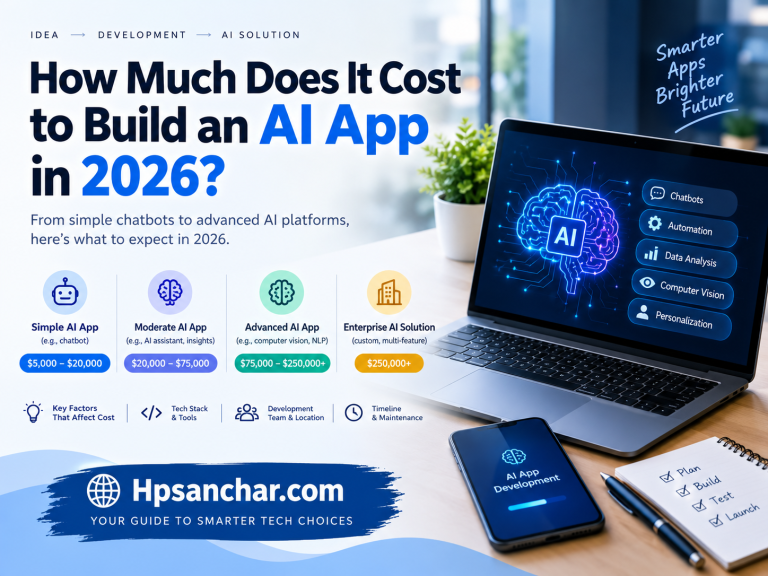
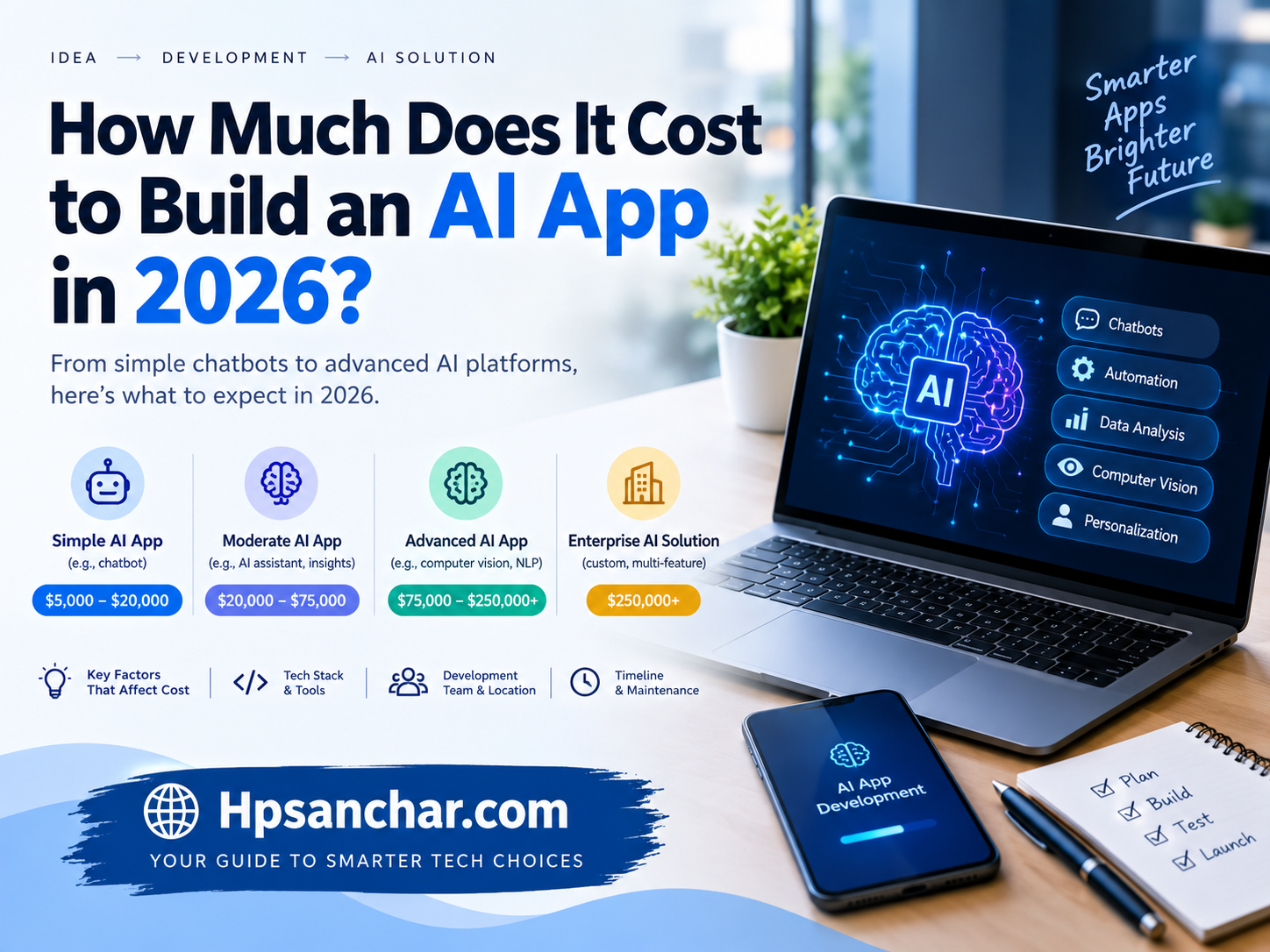
Building an AI application in 2026 typically costs between $20,000 and $400,000+ for initial development, with enterprise-grade autonomous systems easily crossing the $1,000,000 threshold.
The total investment is no longer defined merely by development hours. In 2026, the primary cost drivers center on data pipeline readiness, model orchestration architecture (RAG vs. fine-tuning vs. agents), and ongoing operational inference fees (token OpEx).
AI App Development Cost Breakdown by Complexity Tier
| Project Complexity Tier | Typical Build Cost (USD) | Delivery Timeline | Core Features & Architecture |
| Basic AI Feature / Wrapper | $15,000 – $45,000 | 4 – 8 weeks | Pre-built commercial LLM APIs, standard prompt UI, basic CRM/webhook hooks |
| Production AI MVP / Specialized Tool | $40,000 – $90,000 | 2 – 4 months | Validated data ingest, vector search, evaluation harness, user role controls |
| Enterprise RAG & Agentic Workflow | $90,000 – $250,000 | 4 – 6 months | Multi-agent tool execution, hybrid vector/graph search, guardrails, compliance |
| Custom Fine-Tuned / Multimodal Platform | $250,000 – $750,000+ | 6 – 12+ months | Custom domain-specific models, private GPU inference cluster, real-time audio/vision |
The Anatomy of an AI Budget: Where the Money Goes
A common misstep is assuming the AI model makes up the bulk of the engineering invoice. In reality, the foundation model accounts for roughly 10% to 15% of the build effort; data curation, software engineering, and evaluation infrastructure represent the remaining 85% to 90%.
1. Data Pipeline & Knowledge Preparation ($15,000 – $60,000)
AI models are only as effective as the underlying data context.
-
Cleaning & Tokenization: Scrubbing legacy databases, removing duplicates, and structuring unstructured PDFs or media.
-
Data Labeling & Verification: Domain experts (legal, clinical, or accounting) generating benchmark verification pairs to test accuracy.
-
Vector Indexing: Setting up embeddings and vector databases (Pinecone, Qdrant, pgvector) with hybrid lexical/semantic retrieval.
2. Model Integration & Architecture Choice ($25,000 – $150,000)
Your architectural path dictates both initial development speed and long-term costs:
-
API Wrapper / Pre-trained Models ($10,000 – $35,000): Leveraging APIs like Claude 3.5/4, GPT-4o/5, or Gemini via structured API calls. Quickest time-to-market, but leaves you dependent on third-party pricing.
-
Retrieval-Augmented Generation (RAG) ($40,000 – $100,000): Combining external corporate databases with an LLM. This prevents hallucinations, introduces citation verification, and requires minimal fine-tuning.
-
Agentic Workflows ($70,000 – $180,000): Autonomous systems equipped with reflection loops, memory storage, and API access to perform complex operations (e.g., executing transactions, checking inventory, submitting code).
-
Model Fine-Tuning ($60,000 – $200,000+): Retraining open-weight base models (such as Llama or Mistral) on proprietary industry nomenclature. Demands significant GPU compute (NVIDIA H100/B200 clusters).
3. Core Software Engineering & UI/UX ($30,000 – $120,000)
An algorithm requires a complete application wrapped around it:
-
Frontend Design: Developing dynamic streaming interfaces, response latency animations, and human-in-the-loop review queues.
-
Backend Microservices: Building robust orchestration layers using frameworks like LangChain, LlamaIndex, or custom Python/Rust middleware.
-
Identity & Role-Based Access Control (RBAC): Implementing multi-tenant authentication, SOC 2 Type II audit logging, and data masking.
The Hidden Running Costs: Understanding AI OpEx
The cheapest AI app to build is rarely the cheapest to operate. Unlike traditional software where hosting costs remain relatively flat as user traffic scales linearly, AI operational expenses (OpEx) scale with every query, token, and reasoning step.
Annual operating costs typically range between 15% and 30% of the initial build cost:
-
Model Token Usage & API Charges: Depending on token consumption, token inference costs range from $500/month for low-traffic apps to $20,000+/month for heavy enterprise usage.
-
Vector Database & Cloud Hosting: Hosting high-concurrency vector indexes on AWS, Azure, or GCP generally adds $1,200 to $8,000 per month.
-
AI Evaluations & Drift Monitoring: Real-time observability platforms (Langfuse, Arize, Braintrust) to monitor hallucination rates, token latency, and prompt drift cost $300 to $2,500 monthly.
-
Compliance & Data Privacy Maintenance: Ongoing HIPAA, GDPR, or EU AI Act security audits add roughly $10,000 to $30,000 annually.
Development Team Hourly Rates by Region
| Region | Blended Hourly Rate | Annual Engineer Cost | Strengths & Trade-offs |
| North America (US/Canada) | $120 – $220 / hr | $150,000 – $240,000+ | Seamless communication, top-tier research talent, highest cost base |
| Western Europe | $80 – $160 / hr | $90,000 – $160,000 | Strong compliance & engineering standards, moderate overlapping time zones |
| Eastern Europe / Latin America | $40 – $90 / hr | $50,000 – $95,000 | High technical proficiency, nearshore alignment, strong balance of cost and output |
| South Asia (India) | $25 – $65 / hr | $30,000 – $65,000 | Highest talent scalability, low development rates, requires clear project oversight |
Build vs. Buy: When to Stop Custom Engineering
Before committing six figures to custom AI development, evaluate whether your core value proposition requires bespoke software:
-
Buy Off-the-Shelf SaaS if: The functionality is a standardized business process (such as customer support chatbots, generic document summarization, or sales sequence personalization). Licensing tools like Intercom Fin, Salesforce Agentforce, or Microsoft 365 Copilot provides immediate deployment at a predictable per-seat or per-resolution cost.
-
Build a Custom Solution if: The workflow relies on proprietary internal data, acts as your primary revenue engine, demands strict offline data isolation, or offers an intellectual property moat that out-of-the-box software cannot duplicate.
How to Prevent Budget Overruns
-
Deploy Prompt Caching & Smaller Models: Use frontier reasoning models exclusively for complex tasks. Route simpler queries to smaller open-weight models (such as 8B or 14B parameter models) to cut token inference bills by up to 80%.
-
Phase via MVP to MMP: Launch an initial Proof of Concept to confirm user retention and task accuracy before investing in production-grade fine-tuning.
-
Establish Guardrails Early: Enforce semantic caching so the application retrieves identical cached answers for repeated user queries instead of re-running full model inference.
About the Author