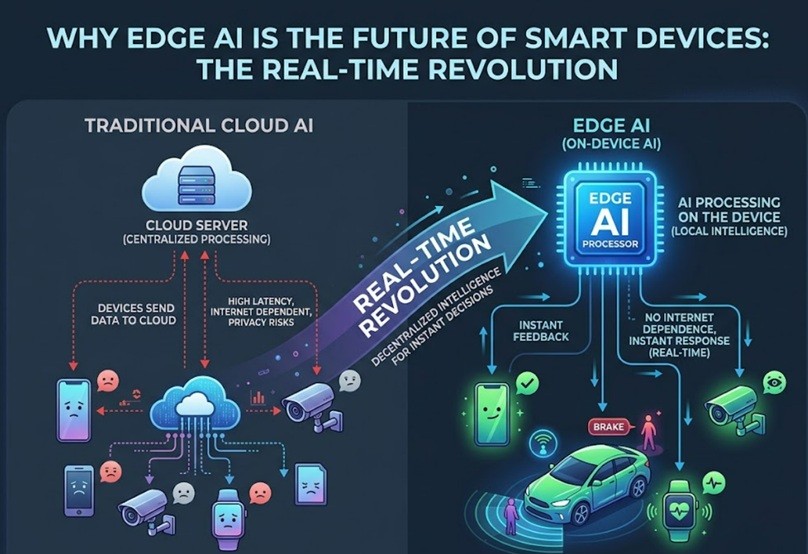
The advanced scene is experiencing a seismic move. For the final decade, the “Cloud” was the undisputed ruler of computing. We got to be usual to our gadgets acting as insignificant conduits, sending information to gigantic, far off information centers to be prepared. But as we request quicker, more private, and more solid insights, the position of authority is being challenged.
Enter Edge AI.
By moving manufactured insights absent from centralized servers and specifically onto the neighborhood device—the “edge” of the network—we are seeing the birth of a modern time for keen innovation. Here is why Edge AI isn’t fair a slant, but the conclusive future of shrewd devices.
What is Edge AI?
At its center, Edge AI is the hone of running machine learning models locally on a device’s equipment or maybe than in the cloud. Whether it’s a smartphone, a security camera, or an mechanical sensor, the information is handled right
1. Zero Inactivity: The Require for Speed
In numerous present day applications, a delay of indeed a few milliseconds can be the distinction between victory and catastrophe.
- Autonomous Vehicles: A self-driving car cannot hold up for a 5G flag to ping a cloud server to choose if a person on foot is in the street. It needs to prepare visual information in real-time to apply brakes.
- Industrial Mechanization: In a savvy manufacturing plant, if a mechanical arm recognizes a mechanical disappointment, it must halt promptly. Edge AI permits for sub-millisecond reaction times that cloud computing basically cannot guarantee.
2. Security and Information Security by Design
Privacy is maybe the greatest driver for customer selection of Edge AI. When you utilize a savvy speaker or a domestic security camera, the thought of your voice or video being put away on a corporate server is a noteworthy “security tax.”
Edge AI flips the script:
- Local Preparing: Your biometric information, confront recordings, and private discussions never take off the device.
- Reduced Assault Surface: Since information isn’t being continually transmitted over the web, there are less openings for programmers to captured touchy data in transit.
3. Transmission capacity Proficiency and Taken a toll Savings
We are living in a “information storm.” A single high-definition security camera can create gigabytes of information each hour. Duplicating that by millions of gadgets makes a enormous bottleneck for worldwide web infrastructure.
By utilizing Edge AI, gadgets ended up “keen channels.” Instep of spilling 24/7 video to the cloud, an Edge AI-enabled camera as it were sends an caution when it recognizes a particular occasion (like a individual entering a limited zone). This radically decreases transfer speed costs and capacity necessities for businesses.
4. Unwavering quality in Farther Locations
The Cloud requires a consistent, steady web association. But the genuine world is messy.
- Agricultural Rambles: Rambles observing crops in country zones frequently have zero cellular reception.
- Subsea Sensors: Gadgets observing oil rigs or submerged cables must work autonomously.
Edge AI guarantees that the “shrewd” portion of the gadget works in any case of the “associated” portion. If the web goes down, the AI remains up.
Key Advances Controlling the Edge
The rise of Edge AI is fueled by breakthroughs in equipment. Conventional CPUs aren’t effective sufficient for the overwhelming lifting of neural systems. Instep, we are seeing the rise of:
- NPUs (Neural Handling Units): Specialized chips outlined particularly to quicken AI errands with negligible control consumption.
- TinyML: A field of machine learning that shrivels complex models down to a few kilobytes so they can run on modest microcontrollers.
- 5G Integration: Whereas Edge AI decreases the require for the cloud, 5G acts as a high-speed bridge between “near-edge” (nearby center points) and “far-edge” (the gadget itself).
Real-World Applications Forming the Future
Healthcare: The Healing center on Your Wrist
Wearables are advancing from straightforward step counters into symptomatic powerhouses. With Edge AI, a smartwatch can analyze heart rate designs (ECG) locally to identify arrhythmias in real-time, cautioning the client to look for therapeutic offer assistance some time recently a cardiac occasion occurs.
Smart Retail: Frictionless Shopping
Retailers are utilizing Edge AI for “warm mapping” and robotized checkout. Cameras handle client developments locally to decide which items are well known without ever recognizing the people, keeping up a adjust between commerce analytics and shopper privacy.
Environmental Monitoring
Edge AI sensors in woodlands can identify the particular sound of a chainsaw or the “scent” of smoke to alarm specialists to illicit logging or rapidly spreading fires inside seconds, long some time recently disciple symbolism would capture the warm signature.
The Challenges Ahead
While the future is shinning, Edge AI isn’t without its hurdles:
- Power Limitations: Running AI models is computationally costly. Engineers must adjust “insights” with “battery life.”
- Model Optimization: Contracting a gigantic GPT-style show to fit on a smartphone without losing precision is a steady scientific battle.
- Fragmentation: Not at all like the standardized environment of the cloud, edge gadgets have fiercely diverse equipment specs, making computer program sending complex.
Conclusion: The Decentralized Intelligence
The move toward Edge AI speaks to a principal alter in our relationship with innovation. We are moving absent from a world where we “inquire” the web for answers and toward a world where our gadgets “know” the answers.
By prioritizing speed, protection, and independence, Edge AI is changing shrewd gadgets from detached instruments into proactive accomplices. As the equipment gets to be more effective and the models ended up more proficient, the boundary between the physical and advanced universes will proceed to blur—and the “insights” will be right there in the palm of your hand.
The future isn’t in the clouds; it’s at the edge.
About the Author