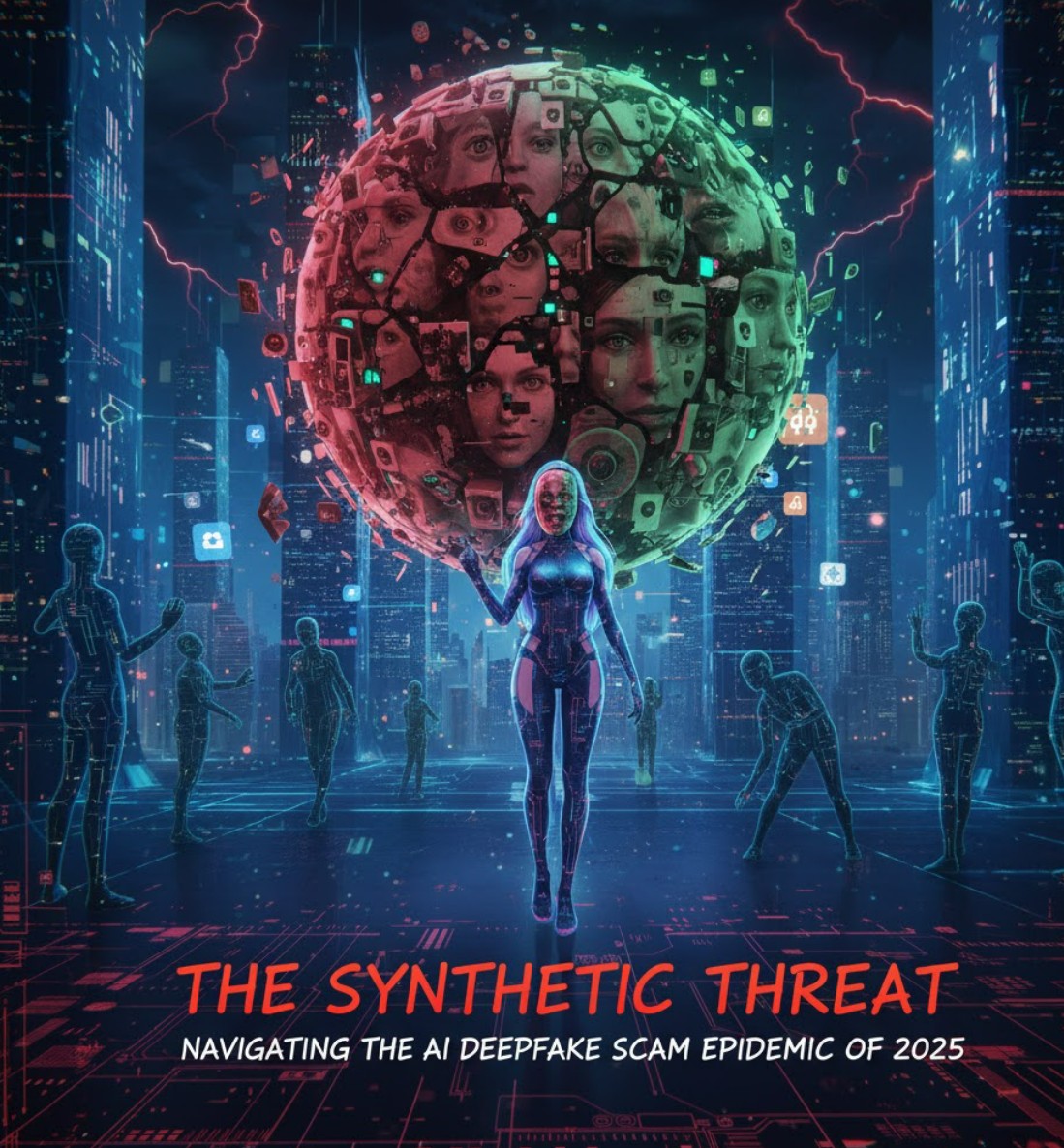
In the digital landscape of 2025, the boundary between the authentic and the fabricated has not just blurred—it has been virtually erased. The pervasive rise of generative Artificial Intelligence, while a boon for creativity and productivity, has simultaneously ushered in a new era of high-impact cybercrime: the AI Deepfake Scam. No longer the grainy, easily-spotted novelty of a few years ago, today’s deepfakes are hyper-realistic, instantly generated, and scalable to an unprecedented degree, posing a systemic risk to global financial and personal security.
Reports from leading cybersecurity firms paint a stark picture, noting a staggering 180% surge in sophisticated AI-powered fraud this year. This escalation is not a slow creep but a rapid, almost exponential climb, with documented financial losses from deepfake-enabled fraud already exceeding hundreds of millions of dollars in the first quarter of 2025 alone. The threat has shifted from mass spam to highly targeted, financially devastating attacks that leverage our fundamental trust in our eyes and ears.
The New Face of Deception: Anatomy of a 2025 Deepfake Scam
The sophistication of current deepfake technology—fueled by powerful, commercially available Large Language Models (LLMs) and generative video tools—has democratized deception. Scammers no longer need advanced coding skills; they simply need a few seconds of a target’s audio or a handful of photos scraped from social media to execute an attack.
1. The Real-Time Corporate Heist: CEO Fraud 2.0
The most financially damaging deepfake scams are targeting the corporate sector. These are not simple phishing emails; they are meticulously orchestrated real-time impersonations.
-
Vishing (Voice Phishing) Attacks: Scammers use AI voice cloning, which can replicate a person’s voice with over 85% accuracy using as little as three seconds of audio, to impersonate executives. The calls are emotionally charged, demanding urgent, confidential wire transfers to a seemingly legitimate, but fraudulent, account. In one notorious case, a finance worker was convinced to authorize a $25 million transfer after a deepfake conference call involving multiple “senior executives.”
-
Video Impersonation: For high-value transactions, deepfakes are deployed during video conferencing. The scammer, using a face-swapping algorithm combined with a voice clone, appears as a known executive, nodding, smiling, and giving non-verbal cues that eliminate traditional suspicion. This is particularly effective in remote work environments where physical verification is impossible.
2. The Emotional Drain: AI-Powered Romance and Family Scams
Deepfakes have weaponized emotional vulnerability, particularly in the realm of romance and personal security.
-
The Synthetic Sweetheart: AI-powered chatbots now manage multiple romance scams simultaneously, engaging in natural, consistent, and round-the-clock conversations. Crucially, they are layered with deepfake videos. A victim of a “pig butchering” scam might spend weeks talking to an AI persona, culminating in a short, convincing deepfake video of their “partner” that solicits an investment or emergency transfer, eliminating the primary red flag of a scammer refusing a video call.
-
The Crying Grandchild: Voice cloning is rampant in “grandparent scams,” where a synthetic voice perfectly mimicking a grandchild calls their elder, claiming to be in urgent legal or medical trouble (e.g., needing bail money). The immediacy and emotional shock override the victim’s critical thinking, leading to hasty transfers of life savings.
3. The Investment Mirage: Celebrity Endorsements
The retail investor is targeted with deepfake videos of global public figures—from tech billionaires to beloved celebrities—seemingly endorsing fraudulent cryptocurrency or “get rich quick” schemes. These videos are often professionally produced, with AI flawlessly syncing the figure’s lips to a script promoting a bogus investment platform. The visual proof of a trusted figure’s endorsement lends a powerful, yet entirely manufactured, sense of legitimacy.
The Unbearable Lightness of Trust: Impact and Mitigation
The ultimate consequence of the deepfake epidemic is not just financial; it is the erosion of trust in all digital media. When seeing and hearing are no longer believing, every video, every phone call, and every digital interaction is placed under suspicion.
The technical gap between deepfake generation and detection is the core problem. While AI is used by criminals to create sophisticated fakes, it is also the best tool for defense.
🛡️ Defensive Strategies for 2025
Combating the deepfake threat requires a multi-pronged strategy encompassing technology, corporate policy, and personal vigilance.
-
For Individuals:
-
Establish a “Safe Word”: For all family members and close colleagues, agree on a simple, unusual family “safe word” or “authentication phrase” that must be used during any urgent financial or sensitive verbal request. A deepfake scammer will not know it.
-
Out-of-Band Verification: Never act on an urgent request from a video or voice call alone. Always verify through a secondary, trusted channel—a return call to a known number, a separate email to a trusted address, or a text message.
-
Slow Down: Scammers rely on panic and urgency. Take a deep breath. Slow down. Legitimate urgent requests can wait one minute for verification.
-
-
For Organizations:
-
Mandate Multi-Factor Authentication (MFA): Implement rigorous zero-trust policies and mandatory MFA for all financial transactions, particularly wire transfers, regardless of the perceived authority of the requestor.
-
Integrate Deepfake Detection Software: Financial institutions and verification platforms are increasingly using liveness detection and behavioral biometrics to spot deepfakes trying to bypass KYC (Know Your Customer) protocols. These AI-driven tools look for anomalies invisible to the human eye, such as subtle flickers or inconsistent head movements.
-
Proactive Employee Training: Regular, realistic simulations of deepfake attacks are critical. Employees must be trained to spot the non-technical red flags: a sudden change in protocol, an unusual request for secrecy, or a rushed timeline.
-
⚖️ The Regulatory Race
Governments are grappling with the speed of AI. The legislative focus for 2025 is on content provenance and transparency. Proposed rules, such as those discussed in major economies like India and the EU, aim to mandate visible labels on all AI-generated content and require platforms to trace the origin of manipulated media. However, technical implementation remains a colossal challenge, and the lack of a unified global response means criminals can simply relocate their operations.
The Future is Synthetic: A Call to Vigilance
The AI deepfake scam is the quintessential security challenge of the new decade. It is not an external hack but an internal compromise of human judgment and trust. As the technology continues to advance—with projections of up to 8 million deepfakes shared online by the end of the year—the line between fraud and reality will continue to dissolve.
Our defense, ultimately, must be multi-layered. We must embrace the defensive power of AI while reinforcing our most basic human security measure: skepticism. In 2025, every digital communication, no matter how familiar the face or voice, must be approached with an attitude of “Verify, then Trust.”