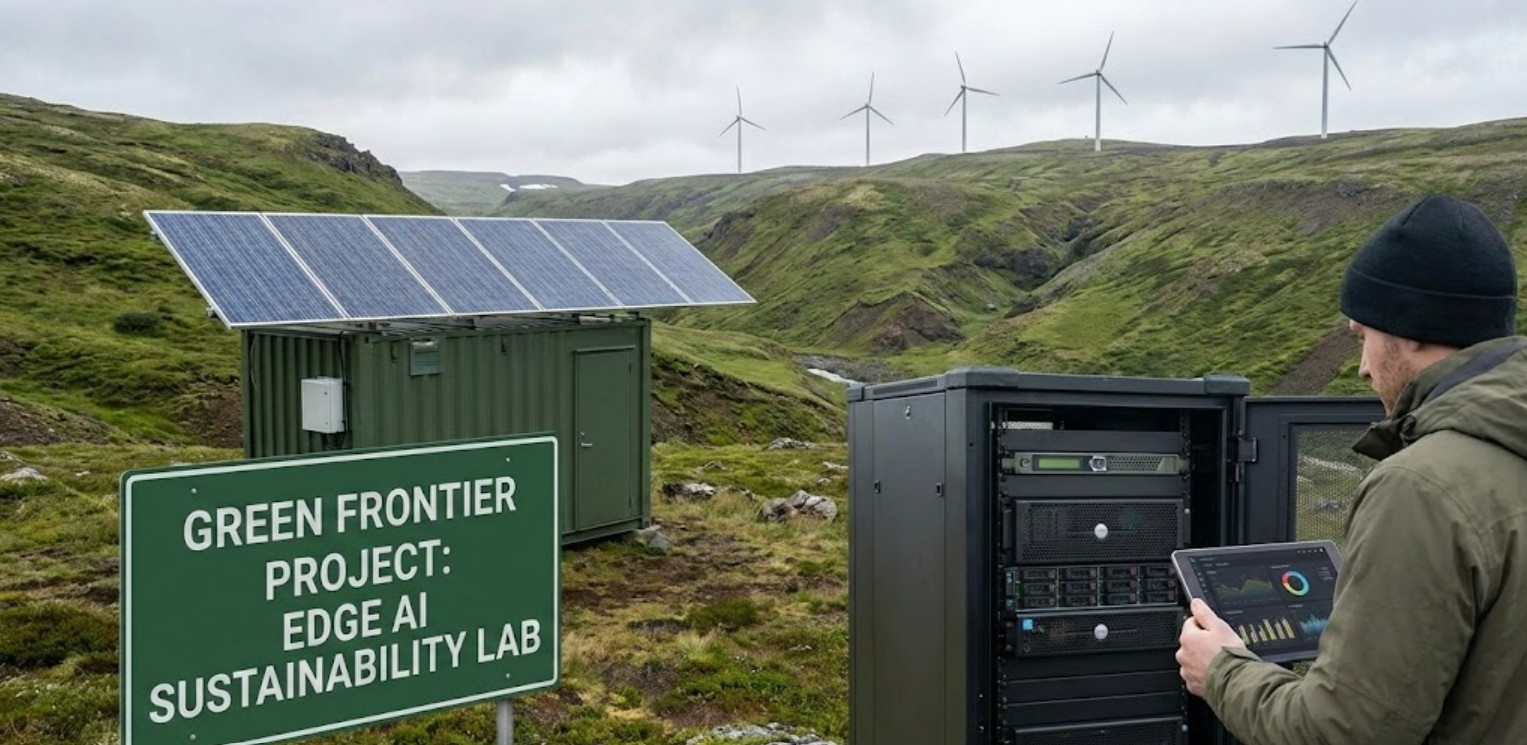
The rise of Artificial Intelligence has presented humanity with a profound paradox. On one hand, AI offers the computational power to solve our most pressing climate challenges—optimizing power grids, designing new battery materials, and monitoring deforestation in real time. On the other hand, the infrastructure required to power this intelligence is becoming one of the world’s largest consumers of energy.
As Large Language Models (LLMs) and generative AI permeate every sector of the economy, the demand for data center capacity is skyrocketing. However, a shift is occurring in how we architect these systems. We are moving away from a purely centralized “cloud-first” model toward a decentralized “edge-first” approach. This transition to Edge AI—processing data locally on devices like smartphones, sensors, and vehicles—is not just a performance upgrade; it is a critical pillar of sustainable IT infrastructure.
The Cloud Conundrum: Why Centralization Costs the Earth
To understand the sustainability value of the Edge, we must first look at the environmental cost of the Cloud. Traditional AI infrastructure relies on hyperscale data centers. While these facilities have become incredibly efficient (low Power Usage Effectiveness, or PUE), they face insurmountable physical limitations:
-
Cooling Demands: Keeping thousands of high-performance GPUs within operational thermal limits requires massive amounts of water and electricity.
-
Transmission Energy: We often focus on the energy used to process data, but we ignore the energy used to move it. Transmitting petabytes of raw video footage or sensor data from a factory floor to a cloud server hundreds of miles away consumes significant electricity across the network infrastructure (routers, switches, fiber optics).
In a centralized model, every single inference request (e.g., asking a smart speaker to turn on lights) travels a round trip to a data center. Multiplied by billions of devices, this creates an enormous, continuous energy overhead.
Enter Edge AI: Processing at the Source
Edge AI reverses this paradigm. Instead of sending raw data to the intelligence, we send the intelligence to the data. By running lighter, optimized AI models directly on the device where the data is generated, we unlock two primary sustainability mechanisms:
1. The Death of Latency and Data Waste
In many IoT (Internet of Things) applications, 99% of data is “noise.” Consider a security camera watching an empty hallway. In a cloud model, that camera streams 24/7 video to a server which processes it only to find nothing is happening.
With Edge AI, the camera processes the feed locally. It only “wakes up” and transmits data when it detects a relevant event (a person). This reduces bandwidth consumption—and the associated energy cost of network transmission—by orders of magnitude.
2. Inference Efficiency
While training a massive AI model requires the brute force of cloud GPUs, inference (using the model) is often much lighter. New generations of hardware, such as NPUs (Neural Processing Units) and DSPs (Digital Signal Processors), are designed to run inference tasks using milliwatts of power, rather than the hundreds of watts consumed by a data center GPU.
TinyML: The Micro-Revolution
The most exciting development in sustainable Edge AI is TinyML. This field focuses on running machine learning workloads on microcontrollers—the tiny, ubiquitous chips found in everything from washing machines to lightbulbs.
Note: A standard cloud GPU might consume 250–400 Watts. A microcontroller running TinyML might consume 1–2 milliwatts. This is a power reduction factor of nearly 100,000x.
TinyML enables “always-on” intelligence with negligible battery drain. For example, a TinyML sensor on a wind turbine can listen to the vibrations of the bearings. It learns the “sound” of normal operation and only alerts technicians when it detects a specific anomaly predicting failure. This predictive maintenance prevents catastrophic breakage and ensures the renewable energy asset runs at peak efficiency.
Real-World Sustainability Use Cases
Edge AI is not just lowering the footprint of IT; it is actively decarbonizing other industries.
-
Precision Agriculture: Instead of blanketing a field with herbicides, tractors equipped with Edge AI cameras can distinguish between a crop and a weed in milliseconds, spraying only the weed. This reduces chemical usage (and the carbon footprint of producing those chemicals) by up to 90%.
-
Smart Grids: As we integrate variable renewables like solar and wind, the grid becomes unstable. Edge AI nodes at substations can balance load and supply in real-time, microseconds faster than a centralized operator could, preventing blackouts and reducing reliance on “peaker” plants (which usually burn fossil fuels).
-
Wildlife Conservation: Solar-powered Edge devices can monitor protected rainforests for the acoustic signature of chainsaws or illegal vehicles, alerting rangers instantly without the need for energy-intensive cellular streaming of audio feeds.
The Hidden Challenge: Embodied Carbon
It is vital to maintain a balanced perspective. While Edge AI reduces operational carbon (the energy used to run the software), it threatens to increase embodied carbon (the energy used to manufacture the hardware).
If the move to Edge AI involves manufacturing 50 billion new disposable “smart” sensors, the environmental cost of mining the silicon, gold, and lithium for those devices could outweigh the energy savings.
Sustainable Edge AI demands a new hardware lifecycle:
-
Longevity: Edge devices must be designed to last 10+ years, not replaced annually like smartphones.
-
Recyclability: Devices must be modular and easy to recycle.
-
Green Manufacturing: The foundries producing these chips must run on renewable energy.
The Future: A Hybrid Architecture
The future of sustainable AI is not “Cloud vs. Edge,” but a hybrid collaboration.
-
Training in the Cloud: Heavy lifting and model updates happen in centralized, water-cooled, renewable-powered data centers.
-
Inference at the Edge: Day-to-day processing happens locally on renewable-powered devices.
-
Federated Learning: Edge devices learn from local data and send only the learnings (model updates), not the raw data, back to the cloud. This preserves privacy and minimizes energy use.
Conclusion
Edge AI represents a maturation of the digital age. We are moving past the era of “gather all data at any cost” to an era of “process smart, process local.” By reducing data transmission, leveraging ultra-low-power hardware like TinyML, and enabling real-time optimization of physical systems, Edge AI is proving that intelligence does not have to come at the cost of the planet.