The integration of Artificial Intelligence (AI) is no longer a futuristic concept—it is a present-day reality rapidly and fundamentally reshaping the modern workplace. Accelerated by breakthroughs in Generative AI (GenAI) and machine learning, AI adoption is surging across virtually every industry, from high-tech manufacturing to cognitive-intensive white-collar professions.
This mass adoption is not merely an incremental technological upgrade; it is a transformative force that is redefining job roles, demanding new skills, boosting efficiency, and challenging traditional business models. The workplace of tomorrow is being built today, and its blueprint is heavily influenced by the capabilities of intelligent systems.
The AI-Powered Efficiency Revolution
One of the most immediate and tangible impacts of increased AI adoption is the dramatic increase in operational efficiency and productivity. AI systems excel at processing vast amounts of data, identifying complex patterns, and automating repetitive, time-consuming tasks far faster and more accurately than humans.
-
Automation of Routine Tasks: AI tools, including Robotic Process Automation (RPA) and intelligent chatbots, are taking over tasks like data entry, document processing, basic customer inquiries, and scheduling. By offloading these mundane responsibilities, AI frees up human employees.
-
Enhanced Decision-Making: Predictive analytics, powered by AI and machine learning, allows businesses to anticipate market trends, optimize inventory, manage supply chains, and assess cybersecurity risks in real-time. This data-driven decision-making leads to reduced errors and more strategic outcomes.
-
24/7 Availability: AI-powered virtual assistants and customer service agents provide continuous, multilingual support, significantly improving the customer experience (CX) and responsiveness.
Globally, workers who utilize AI tools are reporting saving significant time—often up to two hours a day. The crucial challenge for businesses is ensuring this saved time is translated into meaningful, value-adding work rather than simply more administrative tasks.
Reshaping Job Roles and the Skill Shift
The transformation driven by AI is perhaps most evident in the evolution of job roles. The popular narrative often focuses on job displacement, which is a valid concern, particularly for roles built around repetitive and data-driven execution. However, the more significant and nuanced trend is the elevation and augmentation of human work.
The Rise of the Hybrid Professional
AI is not simply replacing humans; it is enabling a new class of hybrid roles where collaboration with intelligent systems is key. For example, in marketing, professionals use AI to analyze consumer behavior and optimize campaigns, moving from task execution to strategic direction and curation. Similarly, in HR, AI handles routine administration, allowing leaders to focus on employee experience and strategic talent acquisition.
The workforce is moving from a focus on creation to curation and direction. Workers now spend less time generating content from scratch and more time reviewing, refining, and directing AI-generated outputs. This shift emphasizes the vital role of human judgment, context, and ethical reasoning, which AI systems inherently lack.
The New In-Demand Skills
To thrive in the automated age, the required skills are rapidly changing. Technical literacy, once a niche requirement, is now essential across all roles.20 The skills that will keep humans irreplaceable are those that are uniquely human:
| Skill Category | Description |
| Cognitive Skills | Critical Thinking, Complex Problem-Solving, and the ability to interpret and contextualize AI-generated insights. |
| Creative Skills | Innovation, Originality, and the ability to envision new processes, products, and solutions—the ability to invent, not just execute. |
| Socio-Emotional Skills | Emotional Intelligence, Communication, Collaboration, and Nuanced Judgment needed for leadership and high-stakes decision-making. |
| Technical Skills | AI Fluency (effectively using and prompting AI tools), Data Literacy, Cybersecurity, and Ethical/Legal knowledge of AI governance. |
Challenges and Ethical Imperatives
While the opportunities presented by AI are immense, successful integration is not without its hurdles. Organizations must navigate a complex landscape of operational, ethical, and societal challenges.
Ethical Concerns
The reliance on vast datasets for AI training brings critical ethical issues to the forefront. Algorithmic bias, stemming from skewed training data, can perpetuate and even amplify societal inequalities, particularly in sensitive areas like recruitment and finance. Companies must commit to rigorous bias detection and mitigation protocols to ensure fairness and equity. Furthermore, the extensive use of customer and employee data raises significant privacy and data security concerns, demanding strong governance, transparency, and compliance with global regulations.
Organizational and Economic Hurdles
For many businesses, particularly Small and Medium Enterprises (SMEs), the high initial investment in AI software, hardware, and specialized talent can be a substantial barrier. Furthermore, the inherent complexity of integrating AI with legacy infrastructure can slow adoption.
On a societal level, the concern of job displacement remains. If automation leads to a significant loss of routine jobs without corresponding creation of new, accessible roles, it could exacerbate economic inequality. Proactive measures, including comprehensive reskilling and upskilling programs, are critical to support affected workers and ensure a just transition to an AI-driven economy.
The Future of Work: Augmentation and Purpose
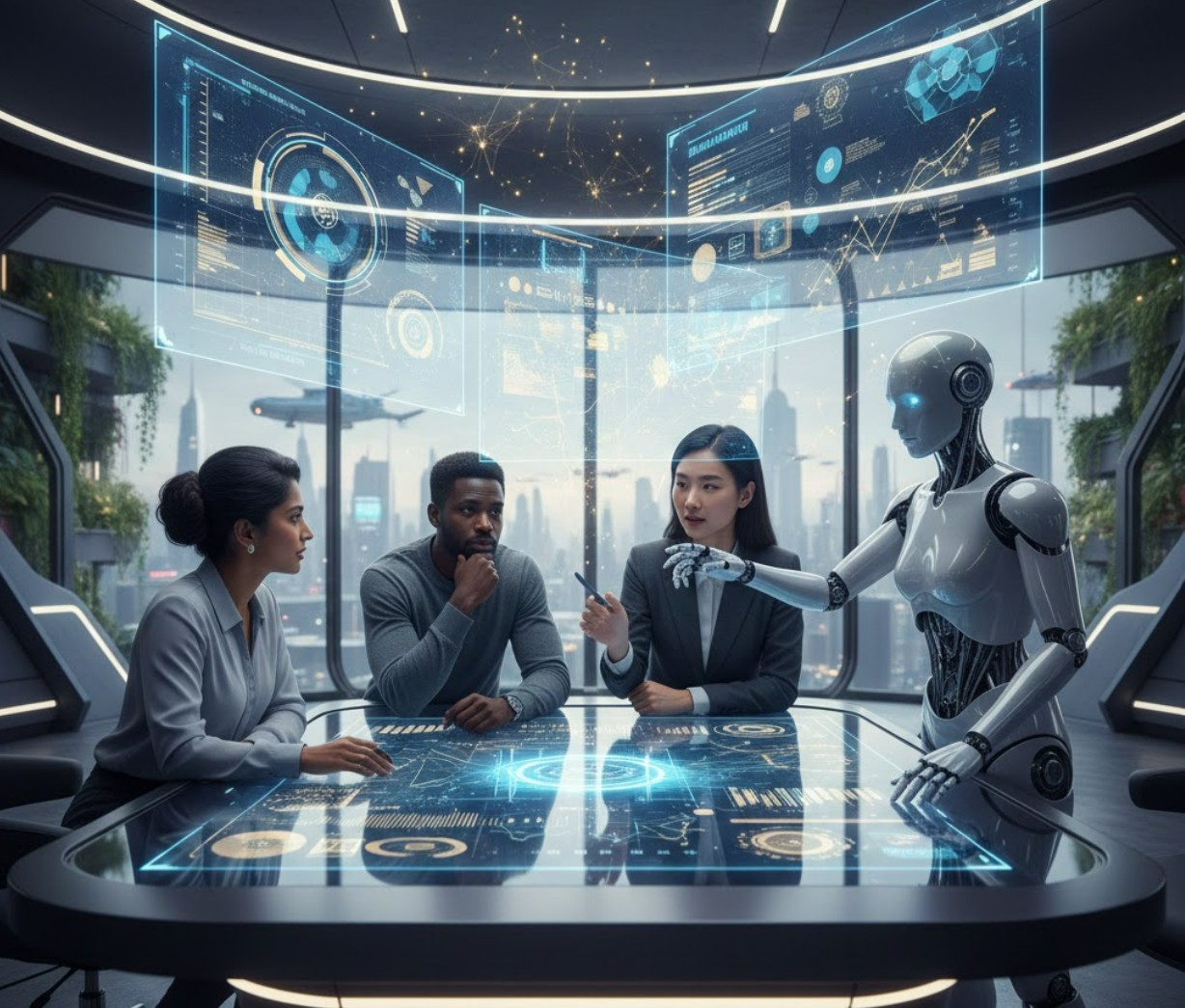
The future workplace will be characterized by a deep and evolving partnership between humans and machines. AI will serve as a powerful augmentative tool, enhancing human capabilities rather than simply substituting them.
For businesses, the key to unlocking AI’s full potential lies in fostering a culture of continuous learning and experimentation. Leaders must lead from the front, demonstrating how AI can be used effectively for simple tasks to build confidence and fluency among their teams.
The most successful organizations will be those that not only invest in the technology but also invest profoundly in their people. As AI handles the routine, the human elements of work—purpose, trust, human connection, and invention—will become the most critical differentiators. By embracing the shift, prioritizing human-centric skills, and establishing robust ethical frameworks, businesses can harness AI to drive not just efficiency, but a richer, more innovative, and more strategic working life for all. The transformation is underway, and adaptability is the currency of the future.
About the Author